I had high hopes for the ATLS instructor course, and felt a little under-prepared and didn't really know what to expect. I learnt a lot, and thought I'd share some of my thoughts - in the hope that maybe other people can be better prepared.
Most importantly, ATLS as a course has a really bad reputation. I don't think it's all ATLS's fault - I think that a lot of it is the fault of the individual instructors. Why? Firstly - slides. You are allowed to omit slides, and add picture slides. You can't alter the text...but there's a lot you can do. Secondly - out of date information - actually, the book may have some of the "older" principles, but the course doesn't focus on them, and allows discussion as long as the principles of ATLS are met.
Preparation
I would suggest:
- Don't read all of the pre-course manual.
- Leave the instructor's manual in its shrink wrap. It's on the CD, and you can read it as a pdf and print off the relevant pages. Open the manual - and then you'll have to decide how to store it in a sensible fashion.
- Re-read the ATLS provider manual. It's there as a pdf on your CD. You need to know it to pass your MCQ - and although you do know it, you need to remind yourself of the "ATLS" way. The MCQs like the random things - like neuroanatomy.
Microteaching
- Plan and rehearse your microteaching.
- The timing is really important - 6 slides, 5 minutes. Title slide, objectives, question and summary = only really 2 slides!
- Interactivity - ask questions
- You can use your own slides or the ATLS slides. Either way make sure you know the slides.
Skill Stations
Prepare by reading the ATLS manual, and watching the DVD. This means you know the "perfect" technique. You don't need to teach the "perfect" technique but you do need to know it -as students will have learnt that. You can then explain why you are deviating from the norm.
You do launch straight into the skills station teaching so make sure it is prepared already.
Critiquing
Stick to Pendleton Plus. It's covered thoroughly in the course, so you should remember it well.
Moulages
You'll be told your moulage scenarios before the course. Take some time to read them. Make sure you bring the moulages + the critiquing form to the moulages.
I struggled a bit to remember everything with the moulages - in retrospect I would highlight the initial scenario (as you need to tell that to the candidate), then write yourself an outline of what happens eg. pneumothorax --> tension --> decompress --> still shocked --> responds to fluids.
Knowledge
There are three causes of error -
Ignorance --> fixed by lectures and skills
Ineptitude --> lazyness - fixed by human factors coaching
Necessary fallibility --> encourage everyone to talk about their errors
Further Reading
- View Sir Ken Robinson's TED talks
- ATLS Manual!
Thursday, 15 January 2015

Tuesday, 13 January 2015
Exacerbation of COPD
Definition of Exacerbation
You'd have thought that defining an exacerbation would be easy...but everywhere seems to have different exacerbation:
- worsening of the patient's symptoms from stable state that is beyond normal day-to-day variations, and is acute in onset.
- Anthonisen criteria - increased dyspnea, increased sputum volume, and increased sputum purulence
Investigations
- CXR in all patients coming into hospital
- ABGs
- ECG
- FBC, U+E
Antibiotics?
- Purulent sputum is often used, but limited accuracy.
- Bloods - markers of infection are hypothetically useful.
- GP notebook advises antibiotics if increased in purulent sputum or suspected pneumonia.
Medical Management
Maximum medical treatment includes:
Controlled oxygen therapy to maintain SaO2 88-92%
Nebulised salbutamol 2.5-5 mg
Nebulised Ipratropium 500 micrograms
Prednisolone 30 mg for 7 to 14 days
Antibiotic agent when indicated
Conflicting evidence about the role of IV magnesium
NIV
NIV should be considered within 60 minutes of arrival to hospital in all patients with an exacerbation of COPD and a persistent respiratory acidosis (pH <7.35 and PaCO2 >6 kPa) in whom medical treatment unsuccessful.
Patients should improve within four hours - if they don't, consider intubation.
Exclusion criteria
Life-threatening hypoxaemia
Severe co-morbidity
Confusion/agitation/severe cognitive impairment
Facial burns/trauma/recent facial or upper airway surgery, vomiting, upper airway obstuction, secretions, inability to protect the airway
Haemodynamically unstable requiring
inotropes/pressors (unless in a critical care unit)
Patient moribund
Bowel obstruction
May be used in heart failure or pneumonia
NIV Technique
- Full face mask for 24hours
- Start with an IPAP of 10cm H20, EPAP of 4-5cmH20
- IPAP should be increased by 2–5 cm increments at a rate of approximately 5 cm H2O every 10 minutes
- Bronchodilators, although preferably administered off NIV, should as necessary be entrained between the expiration port and face mask.
Repeat ABGs:
– after 1 hour of NIV therapy and 1 hour after every subsequent change in settings
– after 4 hours, or earlier in patients who are not improving clinically
Invasive Intubation
NIV failure or inability to tolerate NIV
Respiratory or cardiac arrest
Respiratory pauses with loss of consciousness or gasping for air
Reduced consciousness or uncontrolled agitation
Massive aspiration
Persistent inability to remove respiratory secretions
Heart rate < 50 with loss of alertness
Haemodynamic instability unresponsive to fluid and vasopressors
Life threatening hypoxaemia
Home or Hospital?

Mortality
DECAF score


- If intubated and ventilated have an in- hospital mortality of 25%. Two thirds will be dead within a year. Patients do better than people think.

References
COPD
There are 30,000 deaths per year attributable to COPD.
Pathogenesis of COPD
 COPD is an umbrella term for any airflow obstruction respiratory term. It includes emphysema, chronic bronchitis, resistent asthma, bronchiectasis and to a certain extent, cystic fibrosis.
 Most of it is caused by damage to the lungs from smoking. Cases in young people (younger than 45) should raise the possibility of alpha - 1 - antitrypsin deficiency (2%). Alpha-1-antitypsin protects the alveoli, and deficiency is congenital co-dominant.
Occupational triggers are also possible - heavy exposure to occupational dusts and chemicals, air pollution and cannabis smoking is now being recognised as a cause.
18% of all smokers aged over 35 years will have airflow obstruction
27% of all smokers aged over 35 years with chronic cough will have airflow obstruction
48% of all smokers aged over 60 years and chronic cough will have airflow obstruction
Clinical Presentation
Considered in patients > 35 who have a risk factor and one or more of:
exertional breathlessness
chronic cough
regular sputum production
frequent winter "bronchitis"
wheeze
Signs of right heart failure such as raised JVP, peripheral oedema, hepatomegaly

Rule out red flags for other disease before diagnosing COPD (weight loss, effort intolerance, waking at night, ankle swelling, fatigue, occupational hazards, chest pain, haemoptysis)
Investigations
 Spirometry:
Airflow obstruction: reduced FEV1/FVC ratio: FEV1/FVC is less than 0.7.
Fixed 70% ratio may mean that COPD is being over-diagnosed in elderly people and under-diagnosed in young people.
Chest X-ray
- Increased bronchovascular markings
- Cardiomegaly
- Lung hyperinflation with flattened hemidiaphragms
- Possible bullous changes.
A full blood count to identify anaemia or polycythaemia
An assessment of body mass index (BMI).

It's difficult to completely differentiate COPD from asthma. NICE guidelines have some recommendations.

Treatment Options
Primary prevention (stopping smoking) is the most important intervention. The next step is to ensure a timely diagnosis. Beta blockers are safe.
Inhalers in COPD are used to prevent and control symptoms, reduce the frequency and severity of exacerbations, improve health status and improve exercise tolerance. Stopping smoking is the only measure that can prevent deterioration.
Tiotropium HandiHaler - long-acting antimuscarinic bronchodilator (LAMA). It is once-daily dosing and the most common side effect is dry mouth.

End of Life Care
Patients can die quickly after a COPD exacerbation. It is important that their plans for care at the end of life are discussed and documented. Opioids should be used to alleviate breathlessness at the end of life. Benzodiazepines can be considered.
References
See next blog post
Pictures from http://calgaryguide.ucalgary.ca/

Pathogenesis of COPD
Occupational triggers are also possible - heavy exposure to occupational dusts and chemicals, air pollution and cannabis smoking is now being recognised as a cause.
18% of all smokers aged over 35 years will have airflow obstruction
27% of all smokers aged over 35 years with chronic cough will have airflow obstruction
48% of all smokers aged over 60 years and chronic cough will have airflow obstruction
Clinical Presentation
Considered in patients > 35 who have a risk factor and one or more of:

exertional breathlessness
chronic cough
regular sputum production
frequent winter "bronchitis"
wheeze
Signs of right heart failure such as raised JVP, peripheral oedema, hepatomegaly
Rule out red flags for other disease before diagnosing COPD (weight loss, effort intolerance, waking at night, ankle swelling, fatigue, occupational hazards, chest pain, haemoptysis)
Investigations
Airflow obstruction: reduced FEV1/FVC ratio: FEV1/FVC is less than 0.7.
Fixed 70% ratio may mean that COPD is being over-diagnosed in elderly people and under-diagnosed in young people.
Chest X-ray
- Increased bronchovascular markings
- Cardiomegaly
- Lung hyperinflation with flattened hemidiaphragms
- Possible bullous changes.
A full blood count to identify anaemia or polycythaemia
An assessment of body mass index (BMI).
It's difficult to completely differentiate COPD from asthma. NICE guidelines have some recommendations.
Treatment Options
Primary prevention (stopping smoking) is the most important intervention. The next step is to ensure a timely diagnosis. Beta blockers are safe.
Inhalers in COPD are used to prevent and control symptoms, reduce the frequency and severity of exacerbations, improve health status and improve exercise tolerance. Stopping smoking is the only measure that can prevent deterioration.
Tiotropium HandiHaler - long-acting antimuscarinic bronchodilator (LAMA). It is once-daily dosing and the most common side effect is dry mouth.
Seretide - a very expensive inhaler.
Mucolytics - Increase expectoration of sputum by reducing its viscosity. They can reduce the number of exacerbations and improve symptoms of cough production:
Carbocisteine 750 mg three times daily, reducing to 1.5 g daily in divided doses
Mecysteine 200 mg three times daily for 6 weeks reducing to 200 mg twice daily
LTOT - PaO2 less than 7.3 kPa when stable or a PaO2 greater than 7.3 and less than 8 kPa when stable and one of:
secondary polycythaemia
nocturnal hypoxaemia
peripheral oedema
pulmonary hypertension
End of Life Care
Patients can die quickly after a COPD exacerbation. It is important that their plans for care at the end of life are discussed and documented. Opioids should be used to alleviate breathlessness at the end of life. Benzodiazepines can be considered.
References
See next blog post
Pictures from http://calgaryguide.ucalgary.ca/
Tension Pneumothorax
Tension Pneumothorax
 - One way valve leak. Air is pushed into the pleural space with no means of escape, so collapses the affected lung.
- The mediastinum is displaced to the opposite side.
- Most common cause is mechanical ventilation.
- Signs include chest pain, air hunger, respiratory distress, tachycardia, hypotension, tracheal deviation AWAY from the side of injury, unilateral absence of breath sounds, elevated hemithorax, neck vein distension, cyanosis.
Classic signs of
tension pneumothorax
tension pneumothorax
| Trachea |  | |
| Expansion |  | |
| Percussion Note |  | |
| Breath sounds | | |
| Neck veins | |
Thoracocentesis
5cm needle will reach the pleural space >50% of the time
8 cm needle will reach the pleural space >90% of the time.
Procedure - ATLS Way
- Assess chest and respiratory status
- Administer oxygen and ventilate as necessary
- Identify 2nd intercostal space, midclavicular line
- Surgically prepare the chest. Local anaesthesia if time permits.
- Place patient upright if c-spine injury has been excluded.
- Insert a catheter into the skin, and direct the needle over the rib into the intercostal space.
- Puncture the parietal pleura.
- Remove the needle. Replace the leur lock. Dress.
- Prepare for chest tube insertion


Complications: Local haematoma, pneumothorax,lung laceration, failure
- Placing the needle medially increases the risk of damage to the internal mammary vessels and mediastinum. Lots of experienced ED physicians demonstrated their placement was far too medial.
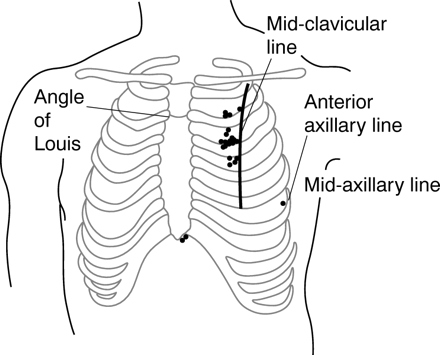 |
| Emerg Med J 2005;22:788–789 |
Discussion Points
- Cannula - lots of discussion about the length of the cannula. In the UK the cannulas we use seem to be quite short compared to other options. Normal IV cannulae do not reach in up to 65% of cases.
- Some places suggest adding a syringe of saline to the cannula so you can see the bubbles as you go. The cannula can also get easily blocked or kinked.
- CXR first? - recently been called into question. Difficult to know if needle has reached pleura, so a CXR can be helpful. If there is no haemodynamic compromise, wait for a chest x-ray. If there is compromise, do not delay.
Leigh-Smith and Harris recommend urgent CXR first in awake patients, except when:
SpO2< 92% on oxygen
Systolic BP< 90 mmHg
Respiratory rate <10
Decreased level of consciousness on oxygen
Cardiac arrest
- Misdiagnosis?
If you think a patient has a pneumothorax, you decompress the chest, and don't hear hiss and the patient doesn't improve, and the CXR shows no pneumothorax - do you still need a chest drain? There's no evidence either way - follow local guidelines.
- Tension gastrothorax has similar symptoms. It is caused by a diaphragmatic tear.
References
http://lifeinthefastlane.com/ccc/emergency-thoracocentesis/
http://emj.bmj.com/content/22/11/788.full
http://emj.bmj.com/content/19/2/176.full
http://journal.publications.chestnet.org/article.aspx?articleid=1060258
http://www.trauma.org/archive/thoracic/CHESTtension.html
http://intensivecarenetwork.com/download/emergency-thoracocentesis-doc/
http://emcrit.org/podcasts/needle-finger-thoracostomy/
http://bestbets.org/bets/bet.php?id=783
http://emergencymedicineireland.com/2012/11/stop-putting-iv-cannulae-in-the-2nd-ics-for-tension-ptx/
Emerg Med J 2005;22:788–789
Friday, 26 December 2014
Pleural Effusion
Pleural effusions are really common. Like a pneumothorax, the size of the effusion doesn't correlate well with the severity of the symptoms. There are two types of pleural effusions - transudate and exudate, and the management and cause of both differs.


The annual incidence of pleural effusion in the developed world has been estimated at 320 per 100,000 population per year.
Pleural fluid is produced by filtering from systemic capillaries within the parietal interstitium and production is greatest at the lung apex. Approx 0.13 mls/kg bodyweight of pleural fluid lubricates the space between the parietal and visceral pleura.
Pleural fluid is absorbed and drained via parietal lymphatic vessels. Normal pleural fluid is formed from the filtration of plasma by healthy parietal pleural membranes and has the following characteristics:
- a glucose content similar to plasma
- low sodium content (1-2 g/dl)
- low white cell count (<1000 cells / mm3)
- low lactate dehydrogenase (LDH) level (<50% that of plasma)
Drug Causes
methotrexate
amiodarone
phenytoin
nitrofurantoin
beta-blockers
granulocyte colony stimulating factor (G-CSF)
Pneumotox Online is a useful website for identifying drug associations with various lung pathologies.
Clinical Features
As well as looking for features of the effusion, remember to look for features of other diseases that may cause the effusion too.
- bronchial breathing may be heard due to consolidated lung above the level of the effusion
- deviation of mediastinum and trachea to opposite side in large effusions
Radiology
- Blunting of the costophrenic angle with effusions around 200ml
- 50ml on a lateral produces blunting
- fluid within the horizontal or oblique fissures
- eventually a meniscus will be seen
- mediastinal shift
- subpulmonic effusion (aka infrapulmonary effusion) may be seen when there is previously established pulmonary disease
Transudate vs Exudate
Unilateral effusion = think carefully - is it cancer??
Put a gas through the gas machine unless it's obviously pus.
Light's Criteria: exudate if ratio of fluid protein to serum protein is >0.5
ratio of fluid lactate dehydrogenase (LDH) to serum LDH is >0.6
fluid LDH is greater than two-thirds the upper limit of normal serum LDH
Transudate
Management is normally based on treating the underlying cause.
Exudate
- 50% of patients with pneumonia develop an effusion and will resolve spontaneously. Empyemas need drainage, so you need to sample the effusion. pH <7.2 = empyema.
Other
- Malignant effusions - cytology diagnostic in 60% of cases. Lung and breast cancer account for 50 - 65% of metastases, and ovarian and gastric cancer account for the rest.
Aspiration
Only aspirate if symptomatic, Aspirations normally suffice and a chest drain is rarely needed but if a drain is placed in the ED, leave it in so that pleurodesis can happen through it.
- Never drain more than 1.5 L at once - may get expansion pulmonary oedema or haemodynamic instability.
- The triangle of safety is marked here. It is bordered by:
The anterior border of latissimus dorsi
The lateral border of pectoralis major
The superior border of the 6th rib
References
Sunday, 21 December 2014
Spontaneous Pneumothorax
There's a lot of of information out there about traumatic pneumothoraces - but the spontaneous ones are much more exciting! They're the ones we get to put drains in without butting a trauma team out of the way! And they are the ones we can make a big difference to by not putting drains into.
Definitions and Numbers
Primary: occurs in healthy people. Thought to be due to rupture of a bleb.
Secondary: underlying lung disease or smokers >50.
Causes 16.7 per 100 000 in men and 5.8 per 100 000 hospital admissions per year.
Risk Factors
Smoking - increases risk in healthy men from 0.1 to 12%
Tall stature, and age over 60 years.
Secondary Risk Factors:
COPD, Asthma
Pulmonary fibrosis, Cystic fibrosis
Pneumonia, TB
Lung cancer
Respiratory complications of HIV and AIDS
Thoracic endometriosis (catamenial pneumothorax) - occurs at the time of (or within 72 hours of) menstruation. Accounts for approximately 5% of pneumothoraces in women. Typically affects 30 - 40 year olds, right lung in 90% of cases. Known endometriosis in a third of cases. Half of cases get a recurrence.
Approximately 1-2% of HIV infected patients and 5-10% of patients with pneumocystis jiroveci (formerly PCP) develop a pneumothorax.
Clinical
Sudden onset of pleuritic chest pain and dyspnoea at rest. Symptoms do not indicate size of the pneumothorax. In many cases the symptoms are mild and approximately half of patients will present after more than 2 days of symptoms.
Diagnosis
CXR- 80- - 85% sensitivity
if supine, often don't see air in the same place as you would elsewhere.
Lateral or decubitus - 18% more PTX, more helpful than an expiratory phase CXR if PTX suspected.
Look for - the deep sulcus sign: when the costophrenic angle is deepened by pleural air, the appearance is referred to as a deep sulcus sign.
Americans measure apex-to-copula distance and judges any distance greater than 3 cm to represent a large pneumothorax. 2010 BTS guidelines clarified that the measurement should be performed at the level of the hilum.

After removal of a chest drain, you may see the track on x-ray.
CT - considered gold standard
USS- operator dependent
Treatment
Oxygen - a pneumothorax resolves four times faster if the patient is on high flow oxygen. Without oxygen, they resolve at 2% of the hemi-thorax volume per day. A 1cm pneumothorax (~25% pneumothorax) would be expected to fully resolve in approximately 12 days. A 2cm pneumothorax (~30-50% pneumothorax) may take 3-4 weeks to fully resolve.


Aspiration - Initial success rate of 60-70%. Successful aspiration is associated with a much higher likelihood of discharge than chest drain insertion with fewer complications. After aspiration, need observation. The BTS guidelines recommend use of a cannula no greater than 16G in diameter for aspiration though evidence that larger cannulae are more likely to cause a persistent pleural leak is limited.

Chest drain for bilateral pneumothoraces or tension pneumothorax, or after a failed needle aspiration.
Suction is not advised, as it often causes re-expansion pulmonary oedema (cough, SOB or chest tightness after insertion of a drain). There is a theory that suction keeps the deficit in the pleura open. Oedema occurs in up to 14% of cases.
Referral
You should refer to a thoracic surgeon if a patient:
Has a second ipsilateral pneumothorax
Has a first contralateral pneumothorax
Has a synchronous bilateral spontaneous pneumothorax
Has a persistent air leak despite five to seven days of chest tube drainage
Has no underlying lung disease and has a persistent air leak despite 5 - 7 days of chest tube drainage
Patients with underlying lung disease, or those with a large air leak, should be referred earlier, after two to four days
Has a failure of lung re-expansion
Has a spontaneous haemothorax
Is in a high risk profession, such as pilots and divers
Is pregnant.
Advice
If the breathlessness recurs, they should return to the ED immediately
They should avoid air travel for at-least a week after the pneumothorax has resolved radiologically. If the pneumothorax was traumatic in origin, two weeks should elapse following confirmed resolution.
They should permanently avoid all types of diving, including scuba.

References
http://learning.bmj.com/learning/module-intro/spontaneous-pneumothorax.html?moduleId=10043183&searchTerm=%E2%80%9Cpneumothorax%E2%80%9D&page=1&locale=en_GB
http://www.enlightenme.org/the-curriculum-zone/medicine/respiratory/spontaneous-pneumothorax/context-and-definition
http://www.enlightenme.org/knowledge-bank/cempaedia/spontaneous-pneumothorax
http://www.enlightenme.org/learning-zone/pneumothorax
http://www.enlightenme.org/the-curriculum-zone/node/12244
http://www.enlightenme.org/the-curriculum-zone/medicine/respiratory/spontaneous-pneumothorax/certificate-0
http://www.enlightenme.org/learning-zone/pop-goes-lung
http://www.enlightenme.org/the-curriculum-zone/node/2157
http://learning.bmj.com/learning/module-intro/.html?moduleId=10048797&searchTerm=%E2%80%9Cpneumothorax%E2%80%9D&page=1&locale=en_GB
http://learning.bmj.com/learning/module-intro/pneumothorax-interpreting-radiology.html?moduleId=10012767&searchTerm=%E2%80%9Cpneumothorax%E2%80%9D&page=1&locale=en_GB
http://learning.bmj.com/learning/module-intro/tension-pneumothorax.html?moduleId=10033841&searchTerm=%E2%80%9Cpneumothorax%E2%80%9D&page=1&locale=en_GB - not in my subscription
http://learning.bmj.com/learning/module-intro/intercostal-drain-open-technique.html?moduleId=10033847&searchTerm=%E2%80%9Cpneumothorax%E2%80%9D&page=1&locale=en_GB - not in my subscription
http://learning.bmj.com/learning/module-intro/chest-x-rays-guide-interpretation-part-2.html?moduleId=10008275&searchTerm=%E2%80%9Cpneumothorax%E2%80%9D&page=1&locale=en_GB
http://lifeinthefastlane.com/ebm-spontaneous-pneumothorax/
http://lifeinthefastlane.com/ccc/pneumothorax-spontaneous/
Definitions and Numbers
Primary: occurs in healthy people. Thought to be due to rupture of a bleb.
Secondary: underlying lung disease or smokers >50.
Causes 16.7 per 100 000 in men and 5.8 per 100 000 hospital admissions per year.
Risk Factors
Smoking - increases risk in healthy men from 0.1 to 12%
Tall stature, and age over 60 years.
Secondary Risk Factors:
COPD, Asthma
Pulmonary fibrosis, Cystic fibrosis
Pneumonia, TB
Lung cancer
Respiratory complications of HIV and AIDS
Thoracic endometriosis (catamenial pneumothorax) - occurs at the time of (or within 72 hours of) menstruation. Accounts for approximately 5% of pneumothoraces in women. Typically affects 30 - 40 year olds, right lung in 90% of cases. Known endometriosis in a third of cases. Half of cases get a recurrence.
Approximately 1-2% of HIV infected patients and 5-10% of patients with pneumocystis jiroveci (formerly PCP) develop a pneumothorax.
Clinical
Sudden onset of pleuritic chest pain and dyspnoea at rest. Symptoms do not indicate size of the pneumothorax. In many cases the symptoms are mild and approximately half of patients will present after more than 2 days of symptoms.
Diagnosis
CXR- 80- - 85% sensitivity
if supine, often don't see air in the same place as you would elsewhere.
Lateral or decubitus - 18% more PTX, more helpful than an expiratory phase CXR if PTX suspected.
Look for - the deep sulcus sign: when the costophrenic angle is deepened by pleural air, the appearance is referred to as a deep sulcus sign.
Americans measure apex-to-copula distance and judges any distance greater than 3 cm to represent a large pneumothorax. 2010 BTS guidelines clarified that the measurement should be performed at the level of the hilum.
CT - considered gold standard
USS- operator dependent
Classic #LungPointSign. Transition point where lung down/up. 100% specific for #pneumothorax #FOAMed #FOAMcc #FOAMus pic.twitter.com/5OBDhoYp14
— Sam Ghali (@EM_ResUS) December 12, 2014Treatment
Oxygen - a pneumothorax resolves four times faster if the patient is on high flow oxygen. Without oxygen, they resolve at 2% of the hemi-thorax volume per day. A 1cm pneumothorax (~25% pneumothorax) would be expected to fully resolve in approximately 12 days. A 2cm pneumothorax (~30-50% pneumothorax) may take 3-4 weeks to fully resolve.
Aspiration - Initial success rate of 60-70%. Successful aspiration is associated with a much higher likelihood of discharge than chest drain insertion with fewer complications. After aspiration, need observation. The BTS guidelines recommend use of a cannula no greater than 16G in diameter for aspiration though evidence that larger cannulae are more likely to cause a persistent pleural leak is limited.
Suction is not advised, as it often causes re-expansion pulmonary oedema (cough, SOB or chest tightness after insertion of a drain). There is a theory that suction keeps the deficit in the pleura open. Oedema occurs in up to 14% of cases.
Referral
You should refer to a thoracic surgeon if a patient:
Has a second ipsilateral pneumothorax
Has a first contralateral pneumothorax
Has a synchronous bilateral spontaneous pneumothorax
Has a persistent air leak despite five to seven days of chest tube drainage
Has no underlying lung disease and has a persistent air leak despite 5 - 7 days of chest tube drainage
Patients with underlying lung disease, or those with a large air leak, should be referred earlier, after two to four days
Has a failure of lung re-expansion
Has a spontaneous haemothorax
Is in a high risk profession, such as pilots and divers
Is pregnant.
Advice
If the breathlessness recurs, they should return to the ED immediately
They should avoid air travel for at-least a week after the pneumothorax has resolved radiologically. If the pneumothorax was traumatic in origin, two weeks should elapse following confirmed resolution.
They should permanently avoid all types of diving, including scuba.
References
http://learning.bmj.com/learning/module-intro/spontaneous-pneumothorax.html?moduleId=10043183&searchTerm=%E2%80%9Cpneumothorax%E2%80%9D&page=1&locale=en_GB
http://www.enlightenme.org/the-curriculum-zone/medicine/respiratory/spontaneous-pneumothorax/context-and-definition
http://www.enlightenme.org/knowledge-bank/cempaedia/spontaneous-pneumothorax
http://www.enlightenme.org/learning-zone/pneumothorax
http://www.enlightenme.org/the-curriculum-zone/node/12244
http://www.enlightenme.org/the-curriculum-zone/medicine/respiratory/spontaneous-pneumothorax/certificate-0
http://www.enlightenme.org/learning-zone/pop-goes-lung
http://www.enlightenme.org/the-curriculum-zone/node/2157
http://learning.bmj.com/learning/module-intro/.html?moduleId=10048797&searchTerm=%E2%80%9Cpneumothorax%E2%80%9D&page=1&locale=en_GB
http://learning.bmj.com/learning/module-intro/pneumothorax-interpreting-radiology.html?moduleId=10012767&searchTerm=%E2%80%9Cpneumothorax%E2%80%9D&page=1&locale=en_GB
http://learning.bmj.com/learning/module-intro/tension-pneumothorax.html?moduleId=10033841&searchTerm=%E2%80%9Cpneumothorax%E2%80%9D&page=1&locale=en_GB - not in my subscription
http://learning.bmj.com/learning/module-intro/intercostal-drain-open-technique.html?moduleId=10033847&searchTerm=%E2%80%9Cpneumothorax%E2%80%9D&page=1&locale=en_GB - not in my subscription
http://learning.bmj.com/learning/module-intro/chest-x-rays-guide-interpretation-part-2.html?moduleId=10008275&searchTerm=%E2%80%9Cpneumothorax%E2%80%9D&page=1&locale=en_GB
http://lifeinthefastlane.com/ebm-spontaneous-pneumothorax/
http://lifeinthefastlane.com/ccc/pneumothorax-spontaneous/
Tuesday, 11 November 2014
Asthma - chronic treatment and management
GPs should be able to manage most asthma. The following points may be beneficial:
Steroids and "New" Drugs
Relvar Ellipta (GSK) is a dry powder inhaler that contains a corticosteroid (fluticasone furoate) and a long-acting beta2 agonist (vilanterol trifenatate). It is licensed for once-daily use as maintenance therapy for COPD and asthma.
Flixotide Evohaler is only available for the over 4s and Budesonide Easihaler only for those over 6. Seretide (fluticasone and serevent) is only for use in over 4s and Symbicort (budesonide and formoterol) only for the over 6s.
Methotrexate at low doses retains anti-inflammatory properties with little toxicity. In chronic severe asthma a number of mixed results have been reported with oral methotrexate.
Clinical issues
General questions, such as “how is your asthma today?” yield a non-specific answer; “I am ok”. Using closed questions, such as “do you use your blue inhaler every day?”, is likely to yield more useful information.
Education is a process and not a single event.
No patient should leave hospital without a written personalised asthma action plan.
Education should include personalised discussion of issues such as trigger avoidance and achieving a smoke-free environment to support people and their families living with asthma.
Brief simple education linked to patient goals is most likely to be acceptable to patients.
Do not recommend house dust mite avoidance to prevention asthma, or pet avoidance.
Treatment of reflux has no benefit in asthma control, although it does reduce dry cough.
Spacers
Single actuations of the metered dose inhaler into the spacer, each followed by inhalation.
Minimal delay between pMDI actuation and inhalation.
Tidal breathing is as effective as single breaths.
Spacers should be cleaned monthly rather than weekly as per manufacturer’s recommendations or performance is adversely affected. They should be washed in detergent and allowed to dry in air. The mouthpiece should be wiped clean of detergent before use.
Plastic spacers should be replaced at least every 12 months
References
http://bestbets.org/bets/bet.php?id=1768
Critical Care and Resuscitation 2005; 7: 119-127
http://onlinelibrary.wiley.com/doi/10.1002/14651858.CD007524.pub3/abstract
http://www.enlightenme.org/knowledge-bank/cempaedia/asthma-adults
http://www.enlightenme.org/the-curriculum-zone/node/2734
http://www.enlightenme.org/knowledge-bank/journal-scan/3mg-trial-randomised-trial-intravenous-or-nebulised-magnesium-sulphate-v
http://onlinelibrary.wiley.com/doi/10.1002/14651858.CD002308.pub2/abstract
http://onlinelibrary.wiley.com/doi/10.1002/14651858.CD002178/abstract
http://www.enlightenme.org/knowledge-bank/cem-ctr/acute-asthma-does-addition-magnesium-sulphate-have-clinically-significant-eff
http://www.enlightenme.org/learning-zone/acute-severe-wheeze-please
http://www.enlightenme.org/the-curriculum-zone/node/3771
http://www.enlightenme.org/knowledge-bank/cempaedia/breathlessness
http://www.aliem.com/lactic-acidosis-beta-agonist-therapy-asthma/
http://learning.bmj.com/learning/course-intro/asthmatic-patient.html?courseId=10046989&locale=en_GB = DONE
http://onlinelibrary.wiley.com/doi/10.1002/14651858.CD002316.pub2/abstract
http://r1.emsworld.com/files/cygnus/image/EMSR/2011/AUG/640x360/pocketguide_patient_10342321.jpg
http://learning.bmj.com/learning/module-intro/quick-tips-asthma.html?moduleId=10050019&searchTerm=%E2%80%9Casthma%E2%80%9D&page=1&locale=en_GB
http://learning.bmj.com/learning/module-intro/.html?moduleId=10051335&searchTerm=%E2%80%9Casthma%E2%80%9D&page=1&locale=en_GB
http://learning.bmj.com/learning/module-intro/occupational-asthma-evidence-based-diagnosis-management.html?moduleId=6051298&searchTerm=%E2%80%9Casthma%E2%80%9D&page=1&locale=en_GB
http://learning.bmj.com/learning/modules/flow/MCQ.html?execution=e9s1&moduleId=10029655&status=LIVE&action=start&_flowId=MCQ&sessionTimeoutInMin=90&locale=en_GB
http://www.enlightenme.org/knowledge-bank/cempaedia/asthma-adults
http://www.enlightenme.org/the-curriculum-zone/node/2734
http://learning.bmj.com/learning/course-intro/asthmatic%20patient.html?courseId=10046989&searchTerm=%E2%80%9Casthma%E2%80%9D&page=1&locale=en_GB
http://dontforgetthebubbles.com/emergency-medicine-clinical-excellence-series-pem-2-allergy-anaphylaxis-children/
http://www.enlightenme.org/knowledge-bank/cem-ctr/acute-asthma-does-addition-magnesium-sulphate-have-clinically-significant-eff
http://www.enlightenme.org/knowledge-bank/journal-scan/3mg-trial-randomised-trial-intravenous-or-nebulised-magnesium-sulphate-v
http://www.enlightenme.org/learning-zone/acute-severe-wheeze-please
http://ccforum.com/content/6/1/30
http://radiopaedia.org/articles/peri-bronchial-cuffing-2
http://radiopaedia.org/articles/asthma-1
http://calgaryguide.ucalgary.ca/slide.aspx?slide=Asthma%20-%20Findings%20on%20Investigations.jpg
http://calgaryguide.ucalgary.ca/slide.aspx?slide=Asthma%20-%20Clinical%20Findings.jpg
http://calgaryguide.ucalgary.ca/slide.aspx?slide=Asthma%20-%20Pathogenesis.jpg
https://www.brit-thoracic.org.uk/document-library/clinical-information/asthma/btssign-asthma-guideline-2014/
https://www.brit-thoracic.org.uk/document-library/clinical-information/asthma/btssign-asthma-guideline-quick-reference-guide-2014/
Steroids and "New" Drugs
Relvar Ellipta (GSK) is a dry powder inhaler that contains a corticosteroid (fluticasone furoate) and a long-acting beta2 agonist (vilanterol trifenatate). It is licensed for once-daily use as maintenance therapy for COPD and asthma.
Flixotide Evohaler is only available for the over 4s and Budesonide Easihaler only for those over 6. Seretide (fluticasone and serevent) is only for use in over 4s and Symbicort (budesonide and formoterol) only for the over 6s.
Methotrexate at low doses retains anti-inflammatory properties with little toxicity. In chronic severe asthma a number of mixed results have been reported with oral methotrexate.
Clinical issues
General questions, such as “how is your asthma today?” yield a non-specific answer; “I am ok”. Using closed questions, such as “do you use your blue inhaler every day?”, is likely to yield more useful information.
Education is a process and not a single event.
No patient should leave hospital without a written personalised asthma action plan.
Education should include personalised discussion of issues such as trigger avoidance and achieving a smoke-free environment to support people and their families living with asthma.
Brief simple education linked to patient goals is most likely to be acceptable to patients.
Do not recommend house dust mite avoidance to prevention asthma, or pet avoidance.
Treatment of reflux has no benefit in asthma control, although it does reduce dry cough.
Spacers
Single actuations of the metered dose inhaler into the spacer, each followed by inhalation.
Minimal delay between pMDI actuation and inhalation.
Tidal breathing is as effective as single breaths.
Spacers should be cleaned monthly rather than weekly as per manufacturer’s recommendations or performance is adversely affected. They should be washed in detergent and allowed to dry in air. The mouthpiece should be wiped clean of detergent before use.
Plastic spacers should be replaced at least every 12 months
References
http://bestbets.org/bets/bet.php?id=1768
Critical Care and Resuscitation 2005; 7: 119-127
http://onlinelibrary.wiley.com/doi/10.1002/14651858.CD007524.pub3/abstract
http://www.enlightenme.org/knowledge-bank/cempaedia/asthma-adults
http://www.enlightenme.org/the-curriculum-zone/node/2734
http://www.enlightenme.org/knowledge-bank/journal-scan/3mg-trial-randomised-trial-intravenous-or-nebulised-magnesium-sulphate-v
http://onlinelibrary.wiley.com/doi/10.1002/14651858.CD002308.pub2/abstract
http://onlinelibrary.wiley.com/doi/10.1002/14651858.CD002178/abstract
http://www.enlightenme.org/knowledge-bank/cem-ctr/acute-asthma-does-addition-magnesium-sulphate-have-clinically-significant-eff
http://www.enlightenme.org/learning-zone/acute-severe-wheeze-please
http://www.enlightenme.org/the-curriculum-zone/node/3771
http://www.enlightenme.org/knowledge-bank/cempaedia/breathlessness
http://www.aliem.com/lactic-acidosis-beta-agonist-therapy-asthma/
http://learning.bmj.com/learning/course-intro/asthmatic-patient.html?courseId=10046989&locale=en_GB = DONE
http://onlinelibrary.wiley.com/doi/10.1002/14651858.CD002316.pub2/abstract
http://r1.emsworld.com/files/cygnus/image/EMSR/2011/AUG/640x360/pocketguide_patient_10342321.jpg
http://learning.bmj.com/learning/module-intro/quick-tips-asthma.html?moduleId=10050019&searchTerm=%E2%80%9Casthma%E2%80%9D&page=1&locale=en_GB
http://learning.bmj.com/learning/module-intro/.html?moduleId=10051335&searchTerm=%E2%80%9Casthma%E2%80%9D&page=1&locale=en_GB
http://learning.bmj.com/learning/module-intro/occupational-asthma-evidence-based-diagnosis-management.html?moduleId=6051298&searchTerm=%E2%80%9Casthma%E2%80%9D&page=1&locale=en_GB
http://learning.bmj.com/learning/modules/flow/MCQ.html?execution=e9s1&moduleId=10029655&status=LIVE&action=start&_flowId=MCQ&sessionTimeoutInMin=90&locale=en_GB
http://www.enlightenme.org/knowledge-bank/cempaedia/asthma-adults
http://www.enlightenme.org/the-curriculum-zone/node/2734
http://learning.bmj.com/learning/course-intro/asthmatic%20patient.html?courseId=10046989&searchTerm=%E2%80%9Casthma%E2%80%9D&page=1&locale=en_GB
http://dontforgetthebubbles.com/emergency-medicine-clinical-excellence-series-pem-2-allergy-anaphylaxis-children/
http://www.enlightenme.org/knowledge-bank/cem-ctr/acute-asthma-does-addition-magnesium-sulphate-have-clinically-significant-eff
http://www.enlightenme.org/knowledge-bank/journal-scan/3mg-trial-randomised-trial-intravenous-or-nebulised-magnesium-sulphate-v
http://www.enlightenme.org/learning-zone/acute-severe-wheeze-please
http://ccforum.com/content/6/1/30
http://radiopaedia.org/articles/peri-bronchial-cuffing-2
http://radiopaedia.org/articles/asthma-1
http://calgaryguide.ucalgary.ca/slide.aspx?slide=Asthma%20-%20Findings%20on%20Investigations.jpg
http://calgaryguide.ucalgary.ca/slide.aspx?slide=Asthma%20-%20Clinical%20Findings.jpg
http://calgaryguide.ucalgary.ca/slide.aspx?slide=Asthma%20-%20Pathogenesis.jpg
https://www.brit-thoracic.org.uk/document-library/clinical-information/asthma/btssign-asthma-guideline-2014/
https://www.brit-thoracic.org.uk/document-library/clinical-information/asthma/btssign-asthma-guideline-quick-reference-guide-2014/
Subscribe to:
Posts (Atom)