Thursday, 22 September 2016

Advanced Life Support

We all know how to manage cardiac arrest, as per ALS. There's always a few little things that I remember, and are good to remind ourselves of. There's also a few little things that we can do and think of as "extras".

Causes of Arrest
The 4Hs and 4Ts are commonly used, and this picture on the left (from Twitter, original source unknown) is a nice way of thinking about it.

 Pyrexia must be prohibited post-cardiac arrest. It is common in the first 48 hours and the risk of a poor neurological outcome increases with each degree rise over 37oC. Maintain normothermia - 32 to 36 degrees.


If we have PEA, it is useful for us to think "Is it wide" or "is it narrow" to help us further hone our diagnostic reasoning.


Drugs

Post ROSC Care
A MAP of about 65-100 mmHg is a reasonable starting point in most –adjusted according to response.


"Special" Circumstances 
Hypothermia:  No adrenaline until >30,
                          double time in between 30 - 35,
                          normal once >35
Drugs are often ineffective and will undergo reduced metabolism.

In primary hypothermic cardiac arrest, death should not be confirmed until:
The patient has been re-warmed
Or
Other unsurvivable injuries have been identified
Or
Re-warming has failed despite all available measures

LA OD
Intralipid
1.5ml/kg bolus AND infusion 15ml/kg / hour
After 5 min 2 further boluses if not better
And double infusion to 30m/kg/hr
Resuscitate for one hour

Lidocaine toxicity
5 Light headedness, circumoral paraesthesia, slurred speech + tinnitus
10 Convulsions, LOC
15 Coma, myocardial depression
20 Resp arrest + arrhythmia
>25 Cardiac arrest

Pregnancy
Peri-mortem c-section


References and Links
http://rebelem.com/a-new-pulseless-electrical-activity-algorithm/
http://www.rcemlearning.co.uk/modules/an-unusual-cause-of-cardiac-arrest/ 
http://www.rcemlearning.co.uk/modules/ooh-cardiac-arrest/ 
http://www.rcemlearning.co.uk/references/post-cardiac-arrest-care-of-the-rosc-patient/ 
http://www.rcemlearning.co.uk/modules/anaphylaxis-induced-cardiac-arrest/
http://www.rcemlearning.co.uk/modules/management-of-post-arrest-patients-including-prognostication/
http://www.rcemlearning.co.uk/modules/a-systematic-review-of-therapeutic-hypothermia-for-non-shockable-cardiac-arrest/
http://www.rcemlearning.co.uk/references/cardiac-arrest-in-special-circumstances-hypothermic-cardiac-arrest/
http://www.rcemlearning.co.uk/references/cardiac-arrest-in-special-circumstances-anaphylaxis/
http://www.rcemlearning.co.uk/modules/the-curious-incident-of-the-wolff-in-the-nighttime/
http://www.rcemlearning.co.uk/modules/the-resus-lottery/
http://www.rcemfoamed.co.uk/portfolio/saap-intra-aortic-adrenaline-in-cardiac-arrest/ 

Anaphylaxis

Anaphylaxis is not common, but as prompt treatment is so essential we need to know about it. It's similar in children (covered here) and adults. 


Type 1 Hypersensitivity reaction

Biphasic response occurs in 20% - much debate now about whether or not we need to observe people.

Causes
Antibiotics, especially penicillin
Aspirin
NSAIDs (the second most common cause of drug induced anaphylaxis)

Angiotensin Converting Enzyme Inhibitors


Treatment
Resus Council Algorithm
- Bue needle to inject adrenaline – orange is too short.
- IM injection in the anterolateral aspect of the thigh is best – it is absorbed quicker here than in the deltoid.

- No evidence to support use of H1 antihistamines in anaphylaxis (Sheikh et al 2007). Some evidence of improved skin signs e.g. itching for less severe reactions. Important to remember they can also cause drowsiness, confusion, fatigue and dizziness as side effects.
- H2-antihistamines = no evidence to support their routine use in anaphylaxis (Nurmatov et al 2014). May provide some relief for less emergent skin symptoms.
- Steroids (glucocorticoids) = no evidence to support their routine use in anaphylaxis (Choo et al 2012). The primary reason for administration has been to prevent biphasic reactions (see below), however a recent paper by Grunau et al (2015) found they were not associated with decreased relapses within 7 days.

Investigations
Tryptase sensitivity is low – 21%, especially to foods. It's not recommended in children.
Check tryptase as soon as resuscitation has started, 1-2 hours after symptoms, 24 hours later or in convalescence (some people have raised baseline tryptase levels).

"Special" Anaphylaxis


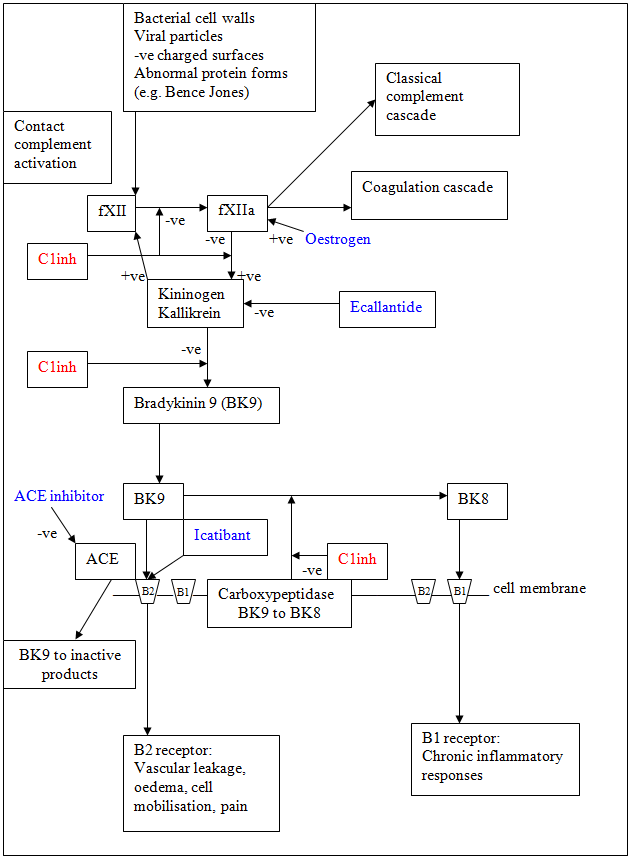
angioedema_bradykinin_pathwayHereditary Angioedema
Often doesn't respond to initial treatment. There's a good picture on RCEMLearning that shows how bradykinin is produced, both from ACE and oestrogen - and this can cause oedema.
Treat with concentrations of plasma and recombinant derived C1 inhibitor, or FFP if that isn't available.
Tranexamic acid may be helpful.

ACE Inhibitor
Excessive accumulation of bradykinin. Usually occurs soon after starting ACEi, but may be years later. Higher incidence amongst women, and African Americans.
It tends to be slowly evolving, with no urticarial or itching. Starts with focal, often asymmetric swelling.
Manage similar to C1 esterase inhibitor deficiency – give some FFP.

Kounis Syndrome 
Anaphylaxis of the coronary arteries – maybe with or without existing coronary disease. There are lots of mast cells in the coronary arteries of people with coronary artery diseases.  Coronary vasospasm is induced. There are no guidelines on how to treat it!

References and Further Reading
http://www.rcemlearning.co.uk/modules/anaphylaxis-induced-cardiac-arrest/
http://www.rcemlearning.co.uk/modules/anaphylaxis/pre-test/
http://www.rcemlearning.co.uk/references/cardiac-arrest-in-special-circumstances-anaphylaxis/
http://www.rcemlearning.co.uk/references/anaphylaxis/
http://www.rcemlearning.co.uk/references/hereditary-angioedema/
http://calgaryguide.ucalgary.ca/type-i-hypersensitivity-pathogenesis-and-clinical-findings/
http://lifeinthefastlane.com/anaphylaxis-amplification/
http://thesgem.com/2013/12/sgem57-should-i-stay-or-should-i-go-biphasic-anaphylactic-response/
http://coreem.net/journal-reviews/biphasic-reactions-in-emergency-department-patients-with-allergic-reactions-or-anaphylaxis/
http://www.ncbi.nlm.nih.gov/pubmed/24239340
https://www.resus.org.uk/anaphylaxis/emergency-treatment-of-anaphylactic-reactions/ 
http://secure.rcem.ac.uk/code/document.asp?ID=5072 
http://kcgs/Documents/CDUPruh013.pdf
http://kcgs/Documents/CDU002.pdf
emergencymedicinecases.com/anaphylaxis-anaphylactic-shock/ 
http://paediatricem.blogspot.co.uk/2013/07/anaphylaxis_29.html

Monday, 15 August 2016

Vertigo

Vertigo is a very difficult topic. Although typically the diagnosis is split into central vs peripheral, it's probably better to think of it as
- investigate now
- investigate later
- No investigations needed.


Peripheral does not equal benign -> eg acoustic neuroma
Central does not equal life threatening -> migraine. Central rarely occurs in isolation, is less intense than peripheral, not possitional, hearing loss and tinnitus are rare and nystagmus is not inhibited by ocular fixation.It normally persists for more than 48 hours. Mild nausea and vomiting.

There are a few great flow charts, and lots of things to think about to work out what the cause is.

1. How long does it last for?
Seconds (psychogenic), Less than 1 min (BPPV), Minutes (Vascular/Ischaemic), Hours
(Meniere's or vestibular migraine), Hours to days (vestibular neuronitis, central causes, MS), Recurrent with headaches (Vestibular migraines).

2. Is it central or peripheral?

3. Dix - Hallpike to see if it's BPPV (peripheral cause)
Don't do it if there's any neck pathology that would make the procedure harmful - like arthritis. If patient dizzy on turning over in bed, BPPV is possible.

Patient in middle of bed. Looks towards one end of bed. Quickly lie flat.
Then over and up to the other side of the couch
Look for nystagmus
Nystagmus is diagnostic.

5. Treat the BPPV with Epley manueuvere:
Lie patient down
Head over couch
Look to side
Quickly turn head to other side - look for nystagmus. Stay there for 30 - 6o sec
Prepare to look at the floor - keep head still and roll onto side
Quickly look at floor
Stay for 30 - 60 seconds
Then sit up and put head down to keep looking at the floor

6. If it's central, HINTs
HI – Head impulse test: This test is a test of the patient vestibulo-occular reflex
Ask patient to look at a fixed target. Rapidly rotate head and look at eyes. A patient with an intact vestibulo-occular reflects will be able to maintain their gaze on the fixed target. The patient who has a defect with one of the vestibules will not be able to maintain gaze and as the head is rotated the eyes will rotate with the head away from the target, after a brief pause will then saccade back to the target. This can be subtle and some people have suggested that it can help
to use a phone with a slow motion app to capture the eye movements.

N - Nystagmus: Nystagmus mixed in peripheral, horizontal in central.
Peripheral vertigo decreases with fixation. Central vertigo persists with fixation.
Peripheral fatigues, central doesn't.
Horizontal, unidirectional never vertical in peripheral vertigo. Any direction for central vertigo.
In peripheral nystagmus resolves within 48 hours, and in central persists beyond 48 hours.


TS- Test of skew: Cerebellum and midbrain are required to allow the eyes to maintain fixed on their target during binocular vision. Cover each eye in turn and when an eye is uncovered looking for vertical deviation of the uncovered eye suggesting the presence of a central lesion.

7. Central Causes
Need ongoing referral and investigation. MRI in the first 48 hours misses 10 - 30% Posterior Circulation Strokes.

8. Treatment
Betahistine is for Meniere's disease only. Seak secondary care advice before starting.

9. Other Investigations
Arrhythmias are rarely the cause of dizziness, but it's worth having a look just incase.
ECG Abnormalities suggestive of arrhythmic syncope
Bifascicular block
Prolonged QRS
Mobitz 1
Brady <50bmp
Sinus pause >3sec
Pre-excited QRS
Long QT
RBBB with ST elevation (Brugada)

10. Look for red flag features
Headache 40% posterior circulation stroke
Gait ataxia May be only non‑vertiginous manifestation of cerebellar stroke
Hyperacute onset Suggests vascular origin
Vertigo and hearing loss AICA or urgent ENT problem
Prolonged symptoms (greater than 4 days) Floor of fourth ventricle problem
Symptoms on valsalva Perilymphatic fistula

References
https://vertigoed.wordpress.com/
http://www.londonscn.nhs.uk/wp-content/uploads/2016/04/neuro-adult-with-dizzy-spells-edu-videos-042016.pdf
http://www.rcemlearning.co.uk/modules/vertigo-will-it-make-your-head-spin/ 

Sunday, 14 August 2016

Sepsis

So Sepsis confuses me. There's loads of guidelines we're supposed to follow (some with out of date evidence) and it's not as simple as it could be. I've tried to simplify it... but might easily have misinterpreted something!

Sepsis = life threatening organ dysfunction due to dysregulated host response to infection. “SOFA” helps define and “prove” organ dysfunction. 

CEM and Surviving Sepsis Criteria define with SIRS
Need at least two of:
Temp > 38.3   Temp <36
WCC >12 or WCC <4
HR >90 RR >20
AMS BM >7.7

Patients with at least two SIRS criteria and suspected infective source should have the sepsis six delivered ASAP (within three hours of time of presentation according to surviving sepsis, within an hour if severe sepsis according to RCEM and most trusts).  Surviving sepsis state within six hours of presentation we need vasopressors, re-assessment and re-check of the lactate.

Septic Shock – need vasopressors to keep MAP >65, lactate >2 despite fluid resuscitation. Sepsis 6 – 30mg/ kg for hypotension or lactate >4.

SOFA Scores
New studies have shown that SIRS is non specific and should no longer used for sepsis prognosis. They instead suggest a “SOFA (sepsis related organ failure assessment)” score where a changing score of > 2 = mortality of 10%.
 The Qsofa is a quick bedside alternative, and >2 factors + suspected infection should make you think of sepsis:
"BAT" BP <100
          AMS
                        Tachypnoea RR >22
This has not made its way into national guidelines yet.

RCEM Guidelines 
Screen for sepsis using “SIRS criteria”
Sepsis risk stratify. Start sepsis six immediately if any one of:
SBP <90mmHg or >40mmHg fall from baseline
MAP <65mmHg
Heart rate >130 per minute*
New need for supplemental oxygen to maintain saturations >90% and bilateral infiltrates.
Respiratory rate >25 per minute*
AVPU = V, P or U*
PaO2 / FiO2 ratio <300 (mmHg) or <39.9 (kPa)
Lactate >2.0mmol/L
Creatinine >176.8µmol/L
INR >1.5
aPTT >60s
Platelet count <100 x109/L
Bilirubin >34.2µmol
Urine output <0.5mL/kg for two consecutive hours

Uncomplicated Sepsis: Decide whether to initiate sepsis six or not, >ST4 review within an hour, hourly obs, repeat lactate in two hours.

Red Flag Sepsis: HR > 130, AVPU less than A, RR >25
If blood results not confirmatory for severe sepsis, senior to review.

Red Flag or Severe: Severe sepsis is no longer in the Sepsis definitions but is in the RCEM guideline. Sepsis six ASAP, but within 60 minutes. >ST4 review. Obs 30minly.  Repeat lactate.

Septic Shock: As above. Inform EM Consultant. Refer to outreach.  Persisting hypotension requiring vasopressors to maintain MAP. Blood lactate >2mmol/L despite adequate volume resuscitation.

NICE Guidelines – July 2016
High risk of sepsis: in <1 year and >75 (or very frail). Immunosuppressed – by drugs or disease. Surgery in past six weeks. Breach of skin integrity. IV drug user. Indwelling lines or catheters. Pregnant or <6 weeks post partum.

Risk stratification for 12years and older – history. Respiratory (>25 or >40% FiO2 to keep sats >92% = high. Moderate = RR 21 – 24). BP (High = <90 or >40 below normal. Mod =91 – 100mmg Hg.). Circ (High = HR >130 bpm, anuric 18 hours, <0.5ml/hour if catheterised. Mod = HR 91 – 130 or new arrhythmia. Anuric 12 – 18 hours. 0.5 – 1ml / kg). Temp (Mod = temp <36). Skin (High = mottled or ashen, cyanosis, non blanching rash. Mod = Skin signs of infection).

There is a different stratification for children <5, and aged 5 – 11.

If >1 high risk criteria, senior clinical decision maker to review. Tests for glucose, lactate, cultures, FBC, CRP, U&E, creatinine, clotting. Antibiotics. Discuss with a Consultant. If septic shock, IV fluids stat, and refer to critical care. If lactate 2-4, give IV fluid bolus within an hour. Lactate <2, consider IV fluids. Monitor every 30minly. Consultant to r/v if failure to respond.

CEM Standards – severe sepsis and septic shock
Observe temp, PR, RR, BP, Mental status, BM on arrival.
Senior EM review within an hour
High flow O2 before leaving ED
Lactate, blood cultures
20mls/ kg fluid – 75% within an hour of arrival, 100% before leaving ED. Antibiotics – 50% within an hour, 100% before leaving ED.
Urine output measured before leaving the ED.

Trials
EGDT: Rivers. Found mortality benefit for EGDT.
ProCESS: Looked at protocol resus vs. usual car in septic shock. More ICU admissions in EGDT group. No difference otherwise.
ARISE: Australia. No advantage of EGDT.
PromMISe: UK based. No advantage over EGDT, which also increases costs.

Some theories: busted!
• Activated protein C - doesn't work
• Steroids - don't work, may be a small role only.
• Intensive insulin therapy - was based on harm from hyperglycaemia now used as moderate therapy only.

CRP
C reactive protein (CRP) is a protein produced by the liver in response to triggers from macrophages and adipose cells, which binds to the surface of dead or dying cells to activate the complement system.
CRP will rise within 2 hours of inflammation onset and peak at 48hrs. A normal level of CRP is not truly known.

References and Resources
http://www.rcem.ac.uk/Shop-Floor/Clinical%20Standards/Sepsis
http://www.heftemcast.co.uk/sepsis-in-the-ed/
http://www.heftemcast.co.uk/sepsis-smaccback/
http://www.frca.co.uk/article.aspx?articleid=100855
http://stemlynsblog.org/early-goal-directed-therapy-dead-st-emlyns/
http://www.survivingsepsis.org/SiteCollectionDocuments/SSC_Bundle.pdf http://stemlynsblog.org/the-promise-study-egdt-rip/
http://stemlynsblog.org/surviving-sepsis-update/
http://foam4gp.com/2015/07/23/foam4gp-map-my-esr-is-bigger-than-your-crp-or-do-we-care-not/

Thursday, 2 June 2016

Iron Overdose

Iron overdose is common, but it is infrequent that it causes severe problems. I have seen it frequently in children, who take their parents well woman tablets, or similar.

Background
When thinking about iron, the first thing that must be done is to convert the amount of iron taken, to the amount of elemental iron ingested. This varies considerably between different types of iron tablets, depending on the type of ferrous or ferric salt:

  ferrous sulfate (dried) — divide dose by 3.3
  ferrous sulfate (heptahydrate) — divide dose by 5
  ferrous gluconate — divide dose by 9
  ferrous fumarate — divide dose by 3
  ferric chloride — divide dose by 3.5
  ferrous chloride — divide dose by 4

You can then risk stratify, by the amount of elemental iron they have ingested:
  <20mg/kg –– asymptomatic
  20-60mg/kg –– GI symptoms only
  60-120mg/kg –– potential for systemic toxicity
  >120mg/kg –– potentially lethal

Peak serum iron levels occur 4-6 hours following iron ingestion, then levels fall due to intracellular shift. Levels do not clearly correlate with clinical toxicity, but > 90 micromol/L (500 mcg/dL) is generally considered predictive of systemic toxicity (equivalent to >60mg/kg)

Pathophysiology
Local Effects - corrosive injury to the GI mucosa (vomiting, diarrhoea, haematemeis, melaena) . Can lead to gastric strictures.

Systemic Effects - cellular toxin, targeting the cardiovascular syndrome. Severe lactic acidosis from hypoperfusion due to volume loss, vasodilation and negative inotropic effects.


Clinical Symptoms


Investigations
Blood gas - can look like DKA. Anion gap metabolic acidosis.
BMs - can be hyperglycaemic
AXR
LFTs, Coags — hepatic failure
U&E — renal failure
Iron levels

Management
**Not adsorbed by activated charcoal**
Whole bowel irrigation for ingestion >60mg/kg
Surgical or endoscopy removal if >120mg/kg or WBI not feasible

Desferroxamine Chelation:
    level >90 micromol/L at 4-6 hours post-ingestion
    evidence of systemic toxicity
    shock
    metabolic acidosis
    altered mental status

Chelates free irons that can be renally excreted. Ferrioxamine is then excreted unchanged in the urine which classically, not reliably, turns a vin rose colour.

15 mg/kg/h, reduced if hypotension occurs, may be titrated up to 40mg/kg/h in severe toxicity
cardiac monitoring is mandatory. Can cause hypersensitivity, ARDS, toxic retinopathy or yersinia sepsis. Can be stopped when the patient is stable and serum iron is <60micromol/L - usually 56 hours.


References
http://learning.bmj.com/learning/modules/elucidat/57067260702df.html?moduleId=10055999&status=LIVE&action=start&_flowId=ELU&sessionTimeoutInMin=90&locale=en_GB&shouldStartAtQuestionSection=false

https://www.aliem.com/2014/management-iron-toxicity/
http://lifeinthefastlane.com/ccc/iron-overdose/
http://lifeinthefastlane.com/toxicology-conundrum-034/
https://wikem.org/wiki/Iron_toxicity
http://lifeinthefastlane.com/tox-library/antidote/desferrioxamine/
http://www.foamem.com/2014/08/06/management-of-iron-toxicity/
http://adc.bmj.com/content/87/5/400.full 
http://lifeinthefastlane.com/cicm-saq-2009-2-q18/ 


Monday, 2 May 2016

Cough

Cough seems a strange thing to have on the syllabus, but we do see lots of patients presenting with cough. They often want antibiotics...and these aren't often the answer. The references at the bottom of the page have got some excellent management guidelines.

Acute Cough
Viral Cough - self limiting. No anti-tussive therapy needed. Efficacy of OTC medications is not compelling. Home based remedies like honey and lemon or honey and coffee.

Chronic Cough
Lasts >8 weeks. Mostly women, with an average age of 55. Can treat empirically before investigations.

Differentials
Pertussis
Tuberculosis
Pulmonary fibrosis - get honeycomb on the CT. Make sure you treat any concurrent reflux,
Reflux - if asymptomatic don't treat. Otherwise, PPI BD + ranitidine. Next step pro-kinetics like metoclopramide.

Drug Differentials 
Latanoprost - augments cough-reflex sensitivity
ACE inhibitors - may take up to several months to stop. ACE inhibitors upregulate the cough reflex
Nitrofurantoin
Bleomycin, methotrexate and amiodarone may cause pulmonary fibrosis

Investigations
CXR
-  if >40 and has ever smoked and has cough, fatigue, SOB, chest pain, weight or appetetite loss.
- if >40 and persistent or recurrent chest infection, clubbing, specific lymphadenopathy, chest signs consistent with lung cancer, thrombocytosis.
Spirometry
Consider checking for sleep apnoea - CPAP may help

Treatment
Treat cause - first generation antihistamines can help.
If cold related consider brompheniramine and SR pseudoephedrine. Naproxen can also help.

References
http://www.rcemlearning.co.uk/modules/a-constant-cough/
http://www.rcemlearning.co.uk/modules/bloody-cough/
http://www.rcemlearning.co.uk/exams/unusual-cough/
http://www.doctors.net.uk/ecme/wfrmNewIntro.aspx?moduleid=1692
http://www.doctors.net.uk/ecme/wfrmNewIntro.aspx?moduleid=1388
http://journal.publications.chestnet.org/data/Journals/CHEST/934853/51496.pdf
http://rebelem.com/long-cough-respiratory-illness-last/
https://www.brit-thoracic.org.uk/document-library/clinical-information/cough/cough-guidelines/recommendations-for-the-management-of-cough-in-adults/
https://www.brit-thoracic.org.uk/document-library/clinical-information/cough/cough-guidelines/recommendations-for-the-management-of-cough-in-children/
http://journal.publications.chestnet.org/data/Journals/CHEST/22039/1S.pdf 

Friday, 29 April 2016

CVP

The CVP
This is the pressure recorded from the right atrium or superior vena cava 
It is representative of the filling pressure of the right side of the heart 

Normal is 8- 12 mmHg in a spontaneously breathing non-ventilated patient
recorded at the end of expiration

It is made up of many different waves:
a = atrial contraction (dominant in pulmonary HTN, TS, PS)
c = closing and bulging of the tricuspid valve (cannon in heart block) 
x = atrial relaxation (absent in AF, exaggerated in tamponade)
v = passive filling of atrium (dominant in TR)
y = opening of the tricuspid valve (sharp in severe TR, constrictive pericarditis. Slow in TR)


Raised CVP 
Fluid overload (although there is a poor relationship)
High PEEP settings (PEEP of 10cm H20 = CVP increase 3cm H20) 

Right ventricular failure
Tricuspid stenosis or regurgitation
Pericardial effusion or constrictive pericarditis
Superior vena caval obstruction

References
http://lifeinthefastlane.com/ccc/cvp-measurement/
Oxford Handbook of Critical Care